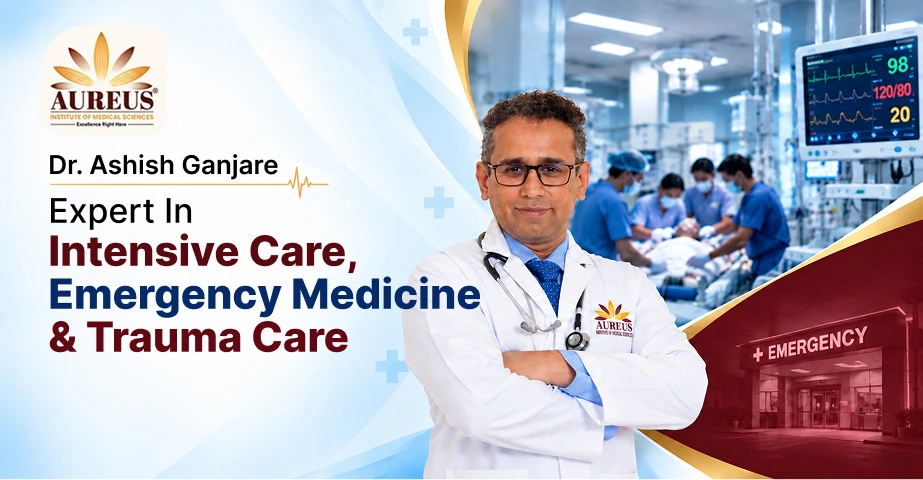
Dr. Ashish Ganjare: Expert in Intensive Care, Emergency Medicine & Trauma Care
In case of any health related emergency, each and every minute matters. If the patient is suffering from several injuries, infection breathing issues or multiple injuries, the problems need to be addressed rapidly. The emergency medicine and critical care team is the one who takes care of all such problems.
When patients are looking for a Critical Care Physician in Nagpur or an Emergency & Trauma Care Specialist in Nagpur, they tend to ask basic questions like how serious an illness is, when it is necessary to put patients in the Intensive Care Unit (ICU) and how does the hospital deals with heavy cases. Dr. Ashish Ganjare is working with intensive care, critical care, Emergency medicine and Trauma care at Aureus hospital, Nagpur.
What Does a Critical Care Physician Do?
People who are suffering from severe health issues or are in extremely critical condition need to be cared for by the critical care physician. These are the doctors who have spec has specialisation to monitor the ongoing condition of the patient and provide ICU treatment.

Critical care is frequent monitoring of breathing rate, blood pressure, heart rhythm or pulse rate, oxygen levels and kidney function. The doctor works closely with other procedures, such as surgeons, anaesthetists, emergency physicians, nurses and other specialists as necessary.
A Critical Care Physician May Be Involved In:
- Providing care when someone is seriously ill, injured or in an emergency to make them stable enough to be treated in hospital for their condition.
- Surveilling patients that may deteriorate rapidly.
- Treatment of respiratory failure, shock, sepsis and other critical conditions.
- Assisting organs that don’t work well.
- Linking up investigations and specialist advice.
- Whether to go to the intensive care unit or another level of care is needed or not.
- Discussing the disease and treatment plan with their family.
The need for the ICU is solely decided by the treating healthcare team depending on the current condition of the patient.
Understanding Emergency Medicine and Trauma Care
Emergency medicine is concerned with the immediate evaluation and management of acute, severe or life-threatening illnesses. Initial concerns are typically those for identifying potential immediate hazards, stabilising the patient and arranging next level care.
An Emergency Medicine Specialist in Nagpur could be asked to evaluate patients with serious infection or chest pain, shortness of breath, seizures, severe bleeding, poisoning, loss of consciousness, or serious injuries.
A trauma injury is an injury sustained in a road crash, fall, work injury or event of high impact and is a condition treated as a trauma injury.
Patients may require emergency surgery or medical treatment, observation or imaging or monitoring in the Intensive Care Unit.
Treatment is coordinated between the treatment team for emergencies and the critical care team in line with the patient’s needs.
When Does a Patient Need Critical Care?
Generally, a patient needs critical care when important organs of the body are damaged. In some of the situations the patient may need continuous monitoring and supervision in ICU (Intensive Care Unit)
Examples may include:
- Very poor breathing or failure to breathe.
- A low blood pressure that has developed due to shock or danger.
- Sepsis or a severe infection.
- Severe trauma, severe bleeding.
- Change in mental alertness or rapid worsening of the nervous system function.
- A condition that causes serious problems at the time of or after surgery.
- Multiple organ dysfunction.
These signs do not automatically mean that every patient needs an ICU.
The treating team decides after examination, investigations, and assessment of the response to initial treatment.
Multi-Organ Failure Treatment: Why Intensive Care needed
Sometimes, a condition arises that if a patient is severely injured or ill, one or more than one organs may be damaged. This condition is multi organ failure. It can occur due to severe infection, major trauma and other serious diseases.
Sometimes, a condition arises that if a patient is severely injured or ill, one or more than one organs may be damaged. This condition is multi organ failure. This condition can occur due to major trauma, infection or other serious disease in the body.
Conclusion
Critical care is for patients who have a serious or life-threatening illness. Emergency medicine is characterised by a need for quick assessment and stabilisation, and trauma and polytrauma care is characterised by a need for co-ordinated assessment across relevant teams. Consider intensive monitoring and organ support – multi-organ failure may occur.
In Nagpur, a patient can get the emergency and critical care evaluation as per medical needs. Dr. Ashish Ganjare works as an intensivist, Emergency physician and Trauma surgeon at Aureus Hospital, Nagpur. Individual clinical assessment needed for treatment.
In the case of a serious medical condition or emergency, promptly seek medical evaluation with family members. Any non-emergency concerns can be discussed with an appropriate consultation to help decide on the next steps in care.