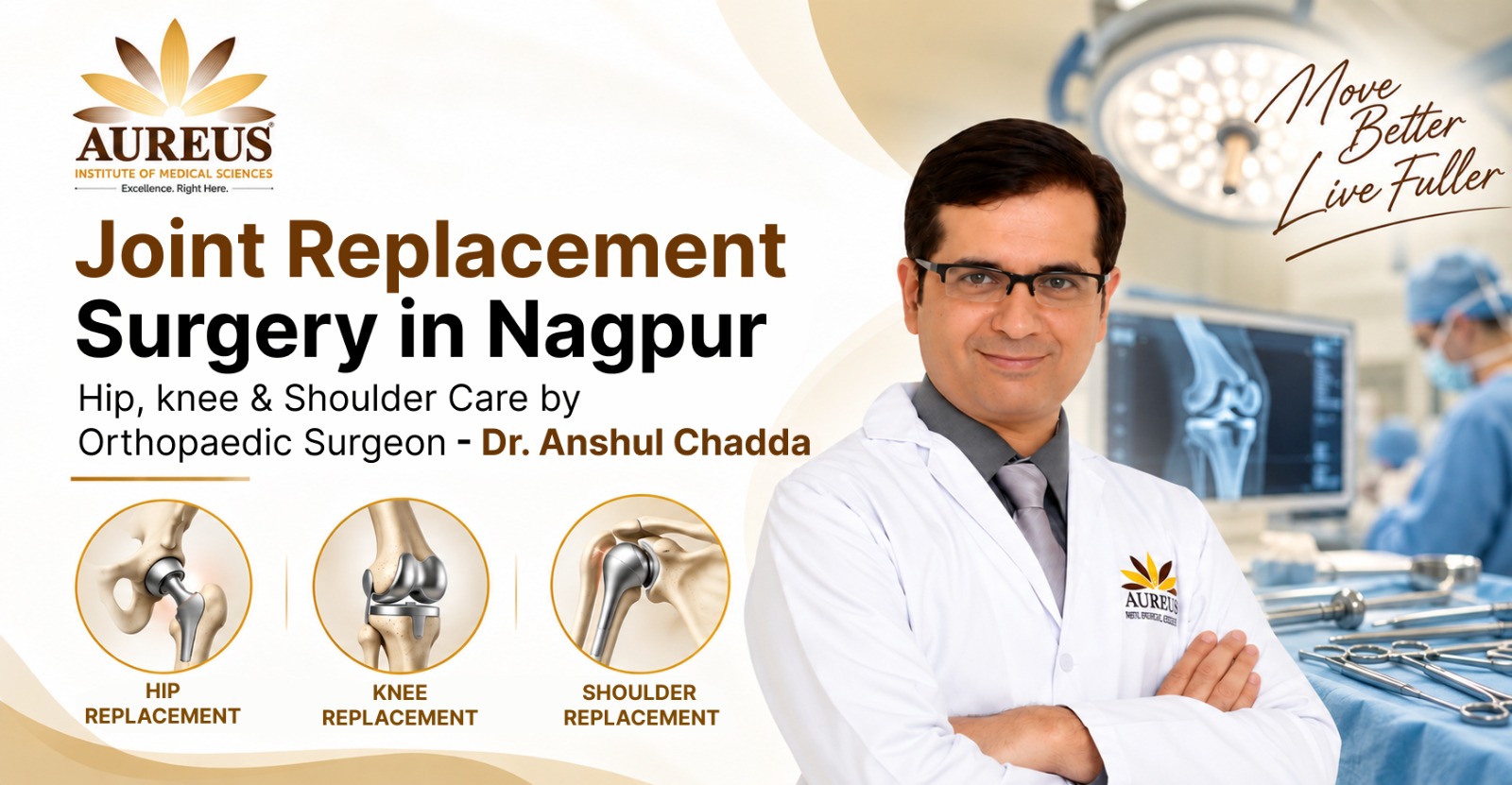
Joint Replacement Surgery in Nagpur : Hip, Knee & Shoulder Care by Orthopaedic Surgeon – Dr. Anshul Chadda
Getting up from a chair feels harder than it used to? Or your knee or hip still hurts long after you’ve climbed the stairs? You’re not alone. Joint pain that doesn’t go away with rest — and slowly starts making everyday tasks harder — is one of the most common reasons people visit an orthopaedic doctor.
In certain cases, particularly in the presence of high-grade arthritis or in case of old injuries to the joints, joint replacement surgery in Nagpur can be one of the treatment options to discuss with a specialist. With the help of orthopaedics doctor Dr. Anshul Chadda, this article explains the ins and outs of joint replacement, when it’s recommended and how Nagpur patients should approach the decision.

What Is Joint Replacement Surgery?
Joint replacement surgery involves the removal of the surfaces of a joint, usually the knee, hip or shoulder, and then replacing them with a man-made implant. The aim is to help a patient with worn down or damaged joint surfaces whose pain and mobility has not been adequately improved with medication and/or physiotherapy be able to have pain reduced and joint mobility restored.
When Is Joint Replacement Surgery Recommended?
However, joint replacement is typically considered when joint damage is severe, the pain becomes chronic and non-surgical interventions don’t alleviate pain.
When a surgeon considers replacement surgery, the following are some common reasons:
Severe and/or advanced osteoarthritis
- Rheumatoid arthritis (RA) can be a disability that interferes with your everyday activities.
- Chronic pain in the joints which fails to get better with rest or medication.
- Any stiffness or loss of motion which can be felt or measured.
- Struggling to walk, climb or perform usual daily activities in the home.
- Damage to the joints caused by a previous injury, fracture or trauma.
Types of Joint Replacement Surgery
Knee Replacement Surgery
Knee replacement is generally recommended for those who have severe knee arthritis or have a large amount of cartilage damage and suffer from knee pain, swelling or trouble straightening or bending the knee. The first symptoms of patients include difficulty in walking up and down stairs, in standing for a long time or in rising from a sitting position after a while.
The basic operation consists of replacing the section of knee joint with a new implant that will allow for smoother motion. Rehabilitation and physiotherapy after surgery are an important part of the recovery process and usually are part of the surgery plan.
Hip Replacement Surgery
Old fractures, avascular necrosis (loss of blood supply to the bone) and osteoarthritis are some of the other conditions that can impact on the hip joint. If hip pain persists and begins to interfere with walking, sleep or everyday activities, there is a time when it is appropriate to seek an orthopaedic opinion about hip replacement.
Generally, hip replacement surgery replaces the broken ball and socket surfaces with an artificial replacement. Individual assessment is more important than generic expectations; the functional goals are different for each patient—such as decreased pain and improved movement.
Shoulder Replacement Surgery
Unlike knee or hip replacement, shoulder replacement rarely comes up in conversation, though it may apply if you have severe arthritis of the shoulder, some complicated fractures or long-standing shoulder pain stemming from rotator cuff problems.
Not all shoulder pain patients will require this option—the type and degree of damage on imaging as well as the impact of pain on their functional abilities will be a key factor in deciding their treatment options. This is a discussion that should be held with an orthopaedic surgeon following appropriate consultation.
Joint Replacement vs. Other Orthopaedic Treatments
The choice of joint replacement is a component of a much wider range of orthopedic treatment options. Depending on the condition and its severity, a surgeon might first consider:
- Medication to help with pain and inflammation.
- Strengthening of surrounding muscles and mobilisation with physiotherapy
- The modification of activity/lifestyle.
- Weight management (if applicable, to joint load)
- Injections, if suitable
- Other conservative or surgical treatment that relates to the condition
This is when joint damage is quite extensive and these options are no longer offering any benefit. Joint replacement is typically the treatment option that enters the equation when joint damage is very severe.
Complex Trauma and Fracture Management
Damage to the joints is not just limited to arthritis. Serious injuries, such as trauma from playing sports, a fall, or road accidents, may cause fractures to bones near or in the joint, which may affect the joint’s mobility and function. This is where complex trauma and fracture management are closely connected with orthopaedic and joint care.
These cases may need a thorough evaluation, surgical planning and even staged treatment as trauma-induced joint damage may be unpredictable compared to that caused by slow wear and tear.
Choosing an Orthopaedic Surgeon in Nagpur for Joint Replacement
Many patient who are looking for the orthopaedic doctor in Nagpur are asking how they will know if they have made an informed decision. Some neutral factors to be taken into account are:
- Appropriate orthopaedic Specialist and clinical experience.
- Experience with the procedure/joint involved.
- Appropriate diagnostic assessment prior to treatment recommendation.
- Clear explanation of options for treatment.
- An informed debate about benefits, risks, surgery alternatives, etc. — not only surgery.
- A clearly outlined plan for rehabilitation and follow-up.
- There is a proper hospital and surgical facilities.
- Clear, convenient dialogue with patients and families.
As an orthopaedic doctor, Dr. Anshul Chadda in Nagpur treats patients in a similar manner.
Conclusion
There are certain patients who may benefit from joint replacement surgery if they have severe and chronic knee, hip or shoulder joint damage but it is not for everyone, and it is not an immediate treatment for all patients. Every case is unique, and requires evaluation, imaging and a realistic discussion of options.
The first step that is helpful for patients in Nagpur considering joint replacement surgery in Nagpur is a thorough orthopaedic consultation with a knowledgeable orthopaedic surgeon – something that is guided by the actual condition of the patient and not a random assumption.